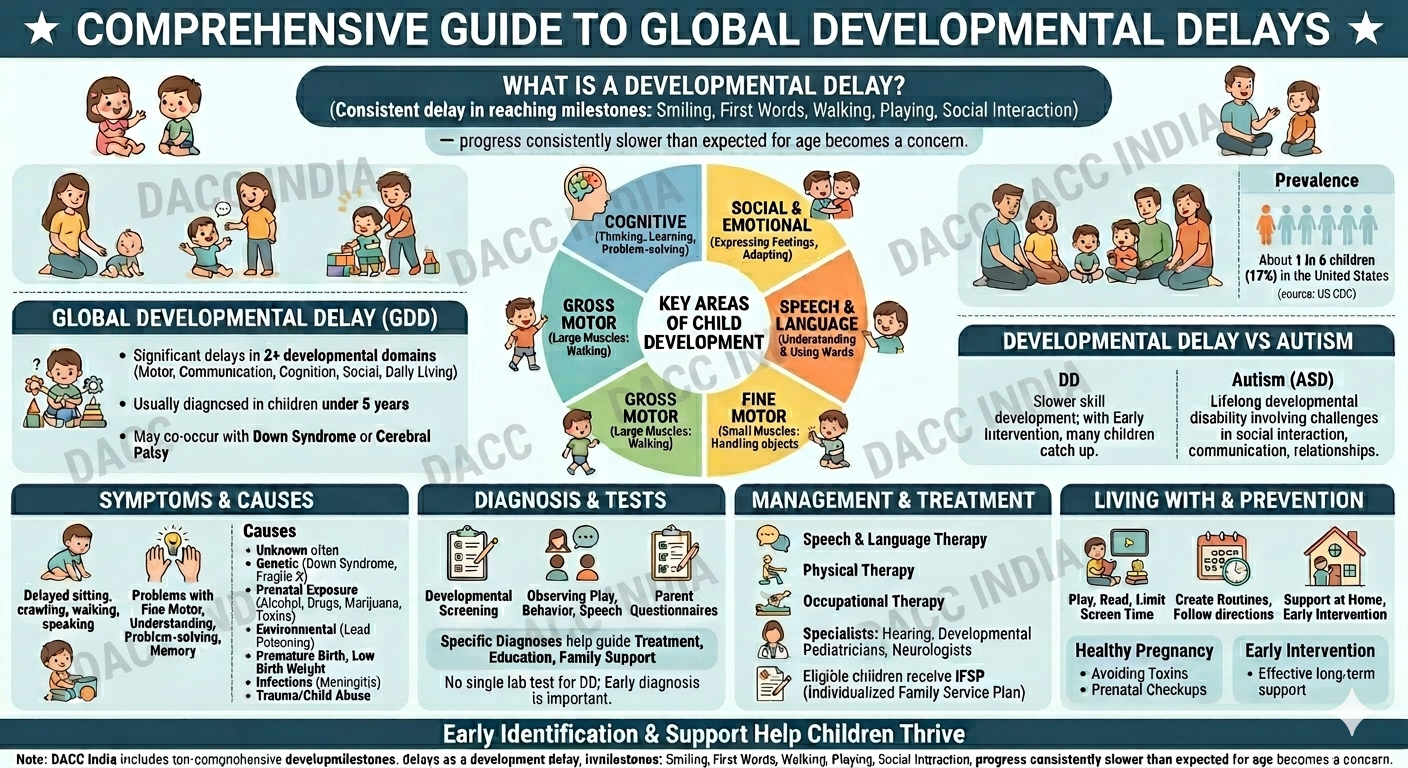
Global Developmental Delay (GDD)
A developmental delay occurs when a child consistently takes longer than peers to reach developmental milestones such as smiling, speaking first words, walking, playing, learning, and social interaction. Children develop at different speeds, so being slightly behind doesn’t always mean a delay; it becomes a concern when progress remains consistently slower than expected for age.
- Child development involves growth in multiple domains:
- Cognitive skills: thinking, learning, problem-solving.
- Social & emotional skills: interacting with others, expressing feelings, adapting to routines.
- Speech & language: understanding and using words.
- Fine and gross motor skills: coordination of small and large muscles (e.g., holding objects, walking).
- A delay can affect one area or multiple areas.
- Global Developmental Delay is diagnosed when significant delays occur in two or more developmental domains, usually in children under 5 years.
- These domains include motor skills, communication, cognition, social skills, and daily living abilities.
- GDD may occur alongside other conditions such as Down syndrome or cerebral palsy.
- Developmental Delay vs Autism
- Developmental delay means slower skill development; with early intervention, many children catch up.
- Developmental disabilities like autism spectrum disorder are typically lifelong and involve challenges in social interaction, communication, and relationships.
- Early intervention is important in both cases to support progress.
- Prevalence
- About 1 in 6 children (17%) in the United States has at least one developmental delay.
Overall: Developmental delay refers to slower progress in reaching milestones, while GDD involves delays across multiple areas. Early identification and support are key to helping children thrive.
Epidemiology
According to the U.S. Centres for Disease Control and Prevention, approximately 1 in 6 children in the United States, or 17%, has at least one developmental delay.
Symptoms and Causes -Etiology
- Developmental delays occur when a child is slower in reaching milestones related to movement, learning, communication, and social skills.
- Common symptoms include delayed sitting, crawling, walking, and speaking.
- Children may also have difficulties with fine motor skills, understanding others, problem-solving, memory, and social interaction.
- Some children struggle to connect actions with consequences.
- Causes of developmental delays are often unknown.
- Genetic conditions such as Down syndrome and fragile X syndrome can contribute to delays.
- Environmental risk factors include exposure to alcohol, drugs, marijuana, or toxins before birth, and lead poisoning after birth.
- Premature birth, low birth weight, lack of oxygen at birth, poor nutrition, and chronic health conditions can increase risk.
- Severe trauma or child abuse may also contribute to developmental delays.
- Other risk factors include severe infections like meningitis and a family history of developmental or learning difficulties.
- In some children, no specific cause can be identified.
Diagnosis and Tests
- Developmental screening helps healthcare providers determine whether a child is meeting expected developmental milestones.
- Screening may involve observing the child’s play, behavior, speech, movement, and interaction.
- Parents may be asked questions or asked to complete questionnaires about the child’s development.
- Developmental screening identifies whether a child may need further evaluation or intervention.
- There is no single lab or blood test for developmental delay, though tests may identify related syndromes or disorders.
- Children may achieve milestones earlier or later than others, so providers assess the child’s overall development.
- Early identification of developmental delays is important because delayed support can worsen learning and development difficulties.
- Early diagnosis and intervention improve long-term outcomes and help children reach their full potential.
- Assessment for Global Developmental Delay (GDD) often includes observing play and collecting developmental history from parents or caregivers.
- Doctors may ask about pregnancy, birth history, early childhood development, and family history.
- Every child develops at their own pace, and developmental differences vary from child to child.
- GDD and intellectual disability may occur alone or alongside conditions such as epilepsy, autism spectrum disorder, or Attention-deficit/hyperactivity disorder.
- A specific diagnosis can help guide treatment, education planning, social care, long-term prognosis, and family counseling
- Diagnosis may also help families access support services, research opportunities, and connect with other affected families.
- A systematic diagnostic approach, including a detailed three-generation family history, is important in identifying possible genetic causes of GDD or intellectual disability.
Management and Treatment
- Children with developmental delays may be referred to specialists for further assessment and support.
- Specialists may include hearing specialists, speech therapists, developmental pediatricians, neurologists, and early intervention providers.
- Early intervention services support infants and toddlers with developmental or health-related challenges.
- These services help children with premature birth, health conditions, delays in communication, learning, movement, play, vision, or hearing.
- Eligible children receive an Individualized Family Service Plan (IFSP) based on their specific needs and family goals.
- The IFSP identifies suitable therapies, activities, and support services for the child’s development.
- Early intervention services may include:
⦁ Assistive technology
⦁ Hearing and audiology services
⦁ Speech and language therapy
⦁ Family counseling and training
⦁ Medical and nursing care
⦁ Nutrition support
⦁ Physical therapy
⦁ Occupational therapy
⦁ Psychological services
Outlook/ Prognosis
- Many developmental delays improve over time, especially with proper support and intervention.
- Early intervention services help children catch up with their peers and achieve their full potential.
- Without early support, developmental delays may become more serious over time.
- Seeking professional help as early as possible is important if a developmental delay is suspected.
Prevention
- Developmental delays cannot always be prevented because the exact causes are often unknown.
- Avoiding harmful toxins during pregnancy and attending regular prenatal checkups may help reduce risk.
- Early intervention is the most effective way to prevent long-term developmental difficulties.
- Research shows that intervention services for children up to 3 years of age can reduce or even prevent the long-term effects of developmental delays.
Living With
- Parents can support children with developmental delays through everyday activities and early intervention services.
- Playing with children helps improve fine motor, physical, social, emotional, language, and communication skills.
- Reading with children supports language development and vocabulary growth.
- Limiting screen time is important because children learn best through real-life interactions and play.
- Creating schedules and routines helps children understand expectations and follow directions more easily.
- Staying in regular contact with healthcare providers and intervention coordinators helps track progress and receive guidance for supporting the child’s development.
A note from DACC India
Developmental delay occurs when a child takes longer than expected to achieve milestones related to speech, movement, learning, and social interaction. Delays may affect one or multiple developmental areas, and significant delays across several domains are known as Global Developmental Delay (GDD). Causes may include genetic, medical, environmental, or unknown factors. Early identification and intervention through therapies and supportive services are essential for improving development and helping children reach their full potential. Parents also play a key role through positive interaction, play, and structured routines.
Refrence links
- https://my.clevelandclinic.org/health/diseases/14814-developmental-delay-in-children
- https://www.alderhey.nhs.uk/conditions/patient-information-leaflets/global-developmental-delay-gdd/
- https://www.mencap.org.uk/learning-disability-explained/learning-disability-and-conditions/global-developmental-delay
- https://pmc.ncbi.nlm.nih.gov/articles/PMC6297696/
Case Study
Ayaan is a four-and-a-half-year-old boy who is currently “running behind” in almost every area of growing up. While most children his age are speaking in full sentences, running easily, and starting to dress themselves, Ayaan is still acting more like a two-year-old. He mostly uses single words or gestures to communicate, struggles with physical tasks like using a spoon or jumping, and often prefers to play by himself rather than with other children. Doctors call this “Global Developmental Delay,” which is a term used for young children who are behind in two or more big areas, like talking, moving, or thinking. It’s like his internal clock for reaching these milestones is moving a bit slower than usual. To help him catch up, he is starting a program that includes speech therapy to help him talk, physical exercises to make his hands and body stronger, and special play-based learning to help his brain process information better. By giving him this extra support now while he is still very young, the goal is to help him bridge that gap and gain as much independence as possible as he grows.
Infographic