Autism Spectrum Disorder
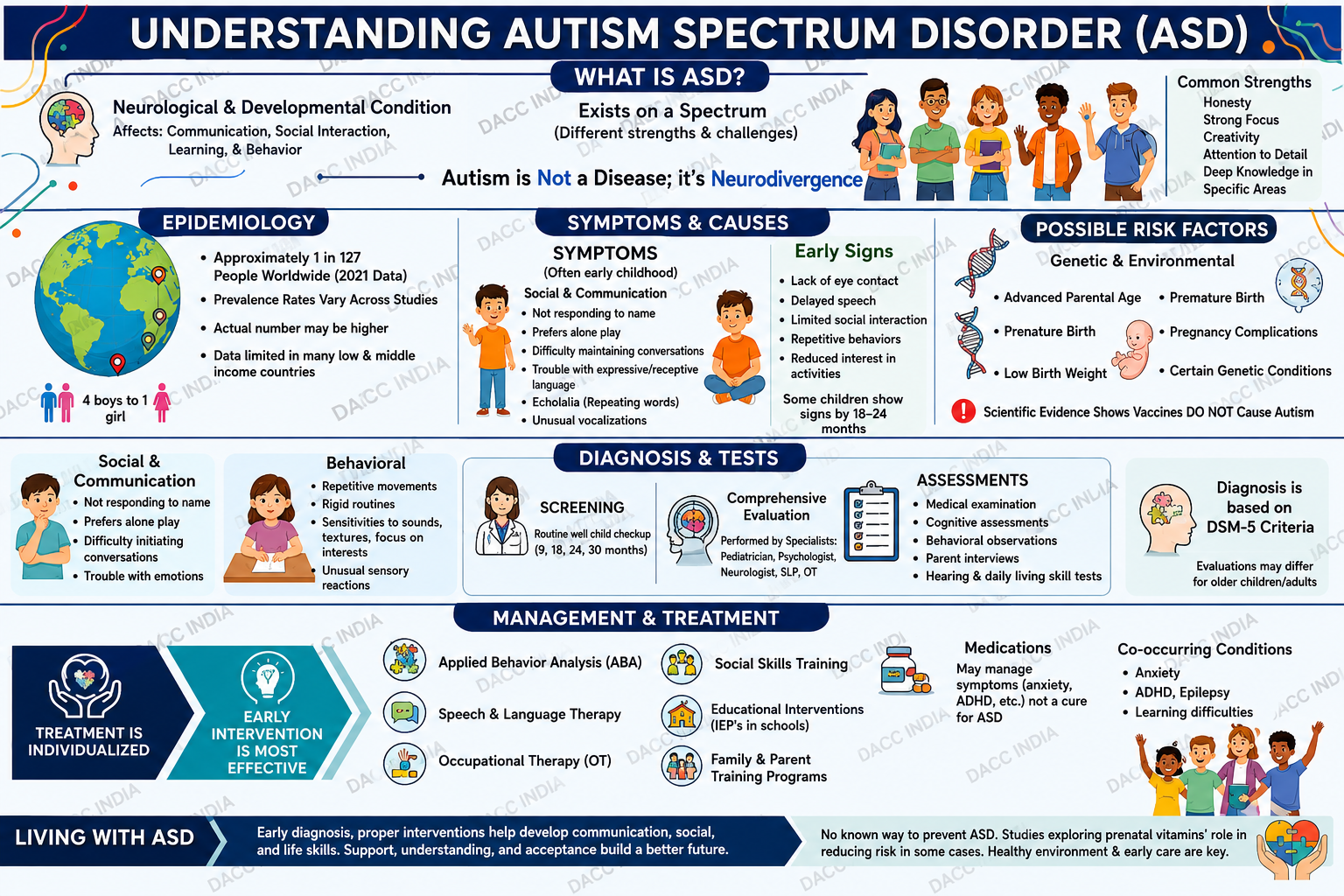
Autism Spectrum Disorder (ASD) is a neurological and developmental condition that affects communication, social interaction, learning, and behavior. Symptoms usually begin in early childhood and may include difficulty with social communication, restricted interests, repetitive behaviors, and unusual reactions to sensory experiences. ASD exists on a spectrum, meaning individuals may experience different levels of strengths and challenges.
People with autism may struggle with school, employment, independent living, and relationships, but many also possess strengths such as honesty, strong focus, creativity, attention to detail, and deep knowledge in specific areas. Autism is not a disease to be cured but a form of neurodivergence. Early diagnosis, therapy, educational support, and family involvement can significantly improve daily functioning and quality of life. Although ASD is lifelong, proper interventions help individuals develop communication, social, and adaptive skills.
Epidemiology
In 2021, autism affected approximately 1 in 127 people worldwide. However, prevalence rates vary across studies, and the actual number may be higher in some populations. Data from many low- and middle-income countries remains limited or unknown.
Symptoms and Causes
- Autism Spectrum Disorder (ASD) usually begins in early childhood, though symptoms may become noticeable later as social demands increase.
- Early signs include lack of eye contact, delayed speech, limited social interaction, repetitive behaviors, and reduced interest in caregivers or peers.
- Some children may lose previously learned speech or social skills between ages 2 and 3 years.
- ASD affects communication, social interaction, behavior, learning, and daily functioning.
- Common social communication difficulties include:
- Not responding to name
- Preferring to play alone
- Difficulty starting or maintaining conversations
- Trouble understanding emotions, gestures, and facial expressions
- Repeating words or phrases (echolalia)
- Speaking in unusual tones or robotic speech
- Behavioral symptoms may include:
- Repetitive movements or behaviors
- Strict routines and resistance to change
- Intense focus on specific interests
- Unusual sensory reactions to light, sound, touch, or temperature
- Intellectual abilities in autistic individuals vary from below average to above average.
- ASD may occur alongside conditions such as anxiety, ADHD, epilepsy, or learning difficulties.
- Causes of autism are not fully known, but both genetic and environmental factors may contribute.
- Possible risk factors include advanced parental age, premature birth, low birth weight, complications during pregnancy, and certain genetic conditions.
- Scientific evidence shows that vaccines do not cause autism.
- Early diagnosis and intervention can improve communication, social, and adaptive skills.
- Many autistic individuals also show strengths such as strong memory, attention to detail, honesty, creativity, and deep focus on interests.
Diagnosis and Tests
- Autism Spectrum Disorder (ASD) is diagnosed through evaluation of a person’s behavior, communication, and development. Early diagnosis, often by age 2, helps children receive timely support and intervention.
- Screening for autism usually occurs during routine well-child checkups at 9, 18, 24, or 30 months. Pediatricians observe developmental milestones and ask parents about the child’s behavior and communication.
- A comprehensive diagnostic evaluation may involve specialists such as pediatricians, psychologists, neurologists, psychiatrists, speech-language pathologists, and occupational therapists.
- Assessments may include:
- Medical and neurological examinations
- Cognitive and language assessments
- Observation of behavior and social interaction
- Parent and caregiver interviews
- Hearing and developmental tests
- Evaluation of daily living skills
- Older children and adolescents may show difficulties with friendships, understanding humor or sarcasm, facial expressions, tone of voice, and social communication.
- Adults seeking diagnosis may experience social communication problems, sensory sensitivities, repetitive behaviors, or restricted interests. Evaluations often include developmental history and interviews with family members.
- Common early signs of autism include:
- Limited eye contact
- Delayed speech and language
- Difficulty understanding emotions and gestures
- Literal interpretation of language
- Trouble making friends
- Repetitive behaviors and strict routines
- Sensory sensitivities to sound, light, or touch
- Diagnosis is based on DSM-5 criteria, which focus on deficits in social communication and repetitive or restricted behaviors.
- There is no single medical test for autism; diagnosis relies on behavioral observation and developmental assessment.
- Early intervention and specialized support can improve communication, social skills, independence, and overall functioning.
Management & Treatment
- Early intervention and support services are most effective when started soon after an Autism Spectrum Disorder (ASD) diagnosis.
- Treatment plans are individualized because people with autism have different strengths, needs, and challenges.
- Interventions may help improve:
- Social communication and language skills
- Daily living and independent functioning
- Behavior management
- Academic and vocational skills
- Common treatment approaches include:
- Applied Behavior Analysis (ABA)
- Speech and language therapy
- Occupational therapy
- Physical therapy
- Social skills training
- Educational and behavioral interventions
- Family and parent training programs
- Special education services and Individualized Education Plans (IEPs) provide school-based support and accommodations.
- Family involvement is important for helping children practice communication, social, and daily living skills.
- There is no cure or single treatment for autism, but therapies can improve learning, communication, behavior, and independence.
- Medications may help manage associated symptoms such as anxiety, hyperactivity, aggression, depression, or sleep problems, though they do not cure autism itself.
- Many autistic individuals may also experience co-occurring conditions such as:
- ADHD
- Anxiety disorders
- Depression
- OCD
- Epilepsy
- Sleep disorders
- Sensory processing difficulties
- Intellectual disabilities
- Cognitive Behavioral Therapy (CBT) and counseling may support emotional and behavioral difficulties.
- Managing autism often requires collaboration among healthcare professionals, educators, therapists, and families.
- Continuous support during adolescence and adulthood helps individuals manage social, emotional, educational, and occupational challenges effectively.
Prevention
The content explains the risk factors and prevention of Autism Spectrum Disorder (ASD). It states that the number of children diagnosed with autism is increasing, though it is unclear whether this is due to better diagnosis, increased awareness, or an actual rise in cases. Autism affects children of all races and nationalities, but certain factors increase the risk.
- Major risk factors include:
- Gender: Boys are about four times more likely to be diagnosed than girls.
- Family history: Families with one child with autism have a greater chance of having another child with the condition.
- Other medical conditions: Disorders such as fragile X syndrome, tuberous sclerosis, and Rett syndrome may increase the risk.
- Premature birth: Babies born before 26 weeks may have a higher risk.
- Older parents: Children born to older parents may have a greater likelihood of autism, though more research is needed.
The content also notes that there is no known way to prevent autism, although studies are exploring whether prenatal vitamins and folic acid during pregnancy may reduce the risk. Finally, it emphasizes that early diagnosis and treatment can significantly improve behavior, language, and social skills, helping children function better over time.
Refrence links
- https://www.mayoclinic.org/diseases-conditions/autism-spectrum-disorder/symptoms-causes/syc-20352928
- https://www.nimh.nih.gov/health/publications/autism-spectrum-disorder
- https://www.psychiatry.org/patients-families/autism/what-is-autism-spectrum-disorder
- https://www.who.int/news-room/fact-sheets/detail/autism-spectrum-disorders
- https://my.clevelandclinic.org/health/articles/autism
A note from DACC India
Autism Spectrum Disorder (ASD) is a lifelong neurodevelopmental condition that affects communication, social interaction, behavior, and learning. Symptoms often appear in early childhood and may include delayed speech, repetitive behaviors, restricted interests, and sensory sensitivities. ASD exists on a spectrum, meaning individuals experience different strengths and challenges. Although the exact causes are not fully known, genetic and environmental factors may contribute. Early diagnosis, therapy, educational support, and family involvement can greatly improve communication, social, and daily living skills. Many autistic individuals also possess strengths such as creativity, honesty, strong focus, and attention to detail.
Case Study
Ankita, a 7-year-old girl studying in Grade 2, was referred for psychological evaluation due to delayed speech, poor eye contact, repetitive behaviors, social difficulties, and sensitivity to loud sounds. She was born prematurely and showed developmental delays during early childhood. Ankita preferred playing alone, had difficulty responding to her name, and often repeated words and phrases. She also displayed resistance to changes in routine and struggled to understand emotions and facial expressions. Despite these challenges, she demonstrated strengths such as strong memory, creativity, and attention to detail.
A comprehensive assessment involving behavioral observation, developmental history, speech and language evaluation, and parent interviews was conducted. Based on DSM-5 criteria, Ankita was diagnosed with Autism Spectrum Disorder (ASD) Level 2 with mild anxiety symptoms. Her condition affected communication, social interaction, academic performance, and daily functioning.
A multidisciplinary intervention plan including speech therapy, Applied Behavior Analysis (ABA), occupational therapy, social skills training, and school support through an Individualised Education Plan (IEP) was recommended. With continuous therapy, educational support, and family involvement, Ankita showed noticeable improvement in communication, emotional regulation, and social interaction over time.
Infographic