Specific Learning Disorder
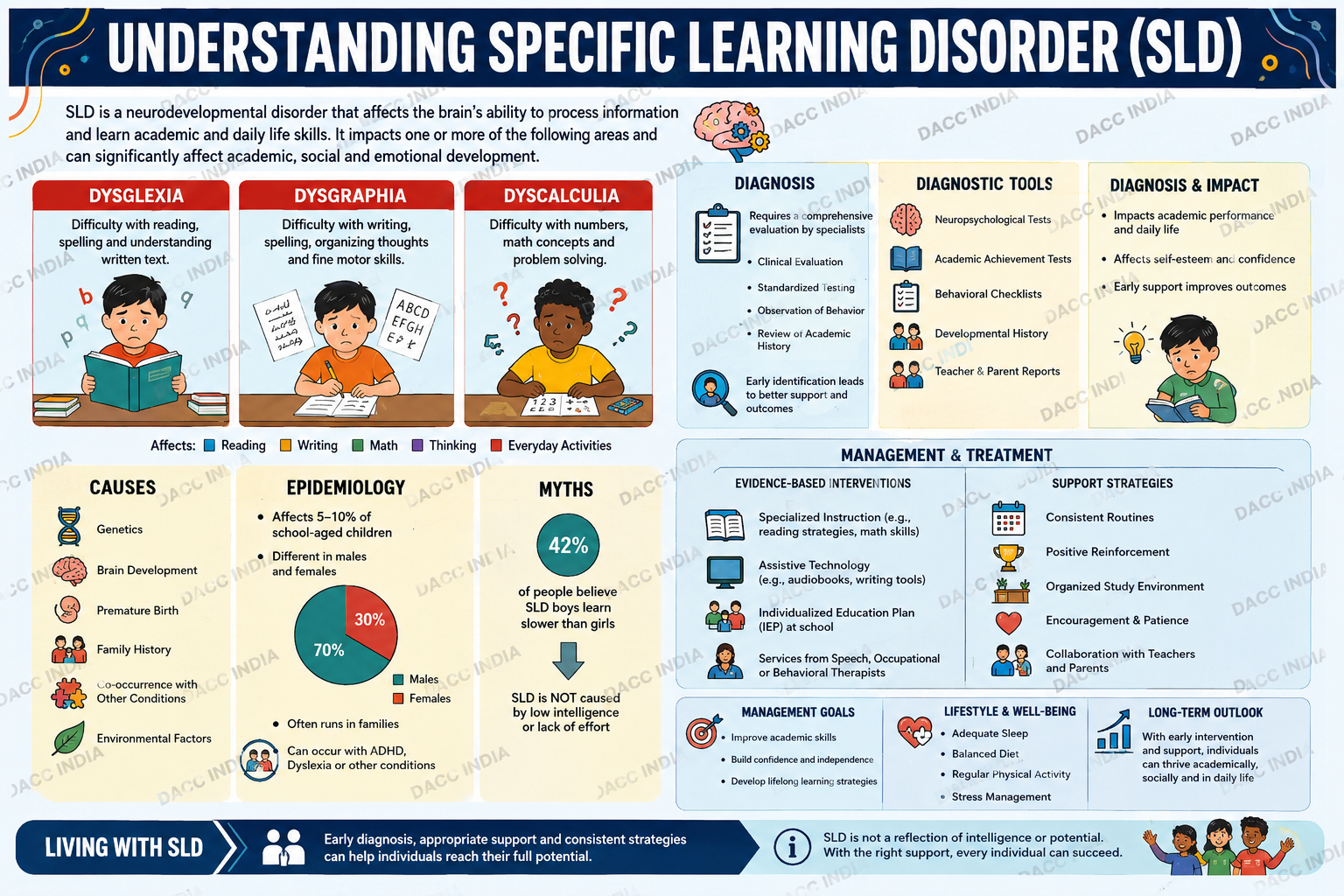
Specific Learning Disorder (SLD), a neurodevelopmental disorder that affects a person’s ability to read, write, spell, speak, listen, or perform mathematical calculations. In the DSM-5, learning disorders such as dyslexia, dysgraphia, and dyscalculia are grouped under the broader term Specific Learning Disorder. These difficulties are not related to low intelligence, as individuals with SLD usually have average or above-average IQ levels. Symptoms often appear during school years and may continue into adulthood if not properly managed.
The three major types of SLD include:
- Dyslexia – difficulty with reading, spelling, decoding words, and reading comprehension
- Dysgraphia – problems with writing skills, grammar, spelling, and organising written expression
- Dyscalculia – difficulty understanding numbers, mathematical concepts, and calculations
SLD severity may be mild, moderate, or severe, depending on the level of support required. Causes may involve neurological, genetic, and developmental factors. Diagnosis is conducted through psychological and educational assessments rather than a single medical test. Early identification, specialised teaching, accommodations, therapy, and family support can significantly improve academic performance and daily functioning. The content also highlights that many children with SLD may experience emotional, social, and self-esteem challenges alongside learning difficulties.
Epidemiology
The content explains that learning disabilities (LDs) are common and affect many children and adults worldwide. Research estimates that about 10% of people in the United States receive a learning disability diagnosis during their lifetime, while around 5% of school-aged children globally have learning disabilities. Dyslexia is identified as the most common type, accounting for at least 80% of learning disabilities.
The statistics also show that learning disabilities are widely recognized in society, with 63% of people knowing someone with a learning disability. However, misconceptions still exist, as 43% of people incorrectly believe that learning disabilities are related to low IQ. In reality, individuals with learning disabilities often have average or above-average intelligence but experience difficulties in specific academic areas such as reading, writing, or mathematics. The content emphasises the importance of awareness, early identification, and proper educational support for individuals with learning disabilities.
Symptoms and Causes
- Learning disabilities (LDs) affect reading, writing, spelling, language, organization, and mathematical skills.
- Common signs of LDs include:
- Difficulty identifying letters, numbers, colours or symbols
- Problems with reading, spelling, and writing
- Trouble following directions and organising tasks
- Difficulty remembering information
- Poor handwriting and math skills
- Problems with attention, coordination, and completing assignments
- Behavioral signs may include:
- Avoiding schoolwork or reading aloud
- Low self-esteem and frustration
- Mood swings or emotional outbursts
- Feeling “not smart” compared to peers
- Social and academic difficulties
- Possible causes and risk factors include:
- Genetic and neurological factors
- Family history of learning disabilities
- Premature birth or malnutrition
- Exposure to alcohol, toxins, or drugs during pregnancy
- Speech or language delays
- Traumatic brain injury and adverse childhood experiences
- Learning disabilities are not related to low intelligence.
- Early identification, assessment, educational support, and intervention can improve academic performance and emotional well-being.
Diagnosis and Tests
Specific Learning Disorder (SLD) is diagnosed when a person shows persistent difficulties in learning for at least six months despite receiving support.
- To diagnose SLD:
- Reading accuracy and fluency
- Understanding written material
- Spelling and written expression
- Mathematical concepts and calculations
- Mathematical reasoning and problem-solving
- Common areas of difficulty include:
- Learning difficulties must significantly affect school, work, or daily functioning.
- Symptoms usually begin during school-age years.
- Difficulties should not be caused by intellectual disability, hearing/vision problems, neurological conditions, or lack of educational opportunity.
- Diagnosis is performed by professionals such as:
- Psychologists
- Pediatricians
- School psychologists
- Educational specialists
- Assessment methods may include:
- Observations and interviews
- Medical and family history
- School reports and academic records
- Standardized educational assessments
- Cognitive and IQ testing
- Psychological evaluations
- Neuropsychological assessments
- Evaluations may also identify related conditions such as:
- ADHD
- Anxiety
- Depression
- Behavioral or emotional difficulties
- Early identification and proper assessment are important for providing:
- Educational support
- Classroom accommodations
- Specialized teaching strategies
- Appropriate intervention plans
Management & Treatment
- Specific Learning Disorders (SLDs) cannot be cured but can be effectively managed with proper support and intervention.
- Early identification and intervention help improve academic performance and self-esteem.
- Individuals with SLD can become successful learners and develop their strengths.
- Educational Support and Services
Students with SLD may qualify for special education services under IDEA (Individuals with Disabilities Education Act).
- Schools may create an Individualised Education Program (IEP) that includes:
- Academic goals
- Support services
- Specialists involved in the child’s education
- Extra time on tests and assignments
- Assistive technology and computers
- Smaller class sizes
- Oral responses instead of written work
- Individualised and structured instruction
- Educators and special education teachers
- Psychologists
- Speech and language therapists
- Occupational and physical therapists
- Educational remediation specialists
- Specialised teaching for reading, writing, and math difficulties
- Behavioural and social skills training
- Strategies to improve organisation and learning skills
- Psychological support for emotional and behavioural difficulties
- No FDA-approved medication specifically treats SLD.
- Medication may help co-occurring conditions such as ADHD or anxiety.
- Low self-esteem
- Anxiety or frustration
- Social difficulties or bullying
- Counseling and social support can improve emotional well-being and social adjustment.
Outlook/ Prognosis
Learning disabilities are lifelong conditions that affect a child’s ability to learn, read, write, or process information. However, with early diagnosis, intervention, and proper educational support, children can improve their skills and adapt successfully. Many individuals with learning disabilities develop personal strengths such as creativity and strong problem-solving abilities and can become successful adults. Early intervention helps reduce academic difficulties and supports positive self-esteem and confidence.
Children with learning disabilities may also face emotional and psychological challenges, including frustration, anxiety, depression, and feelings of low self-worth. Support from parents, teachers, friends, and mental health professionals plays an important role in helping them cope with these challenges. Although learning disabilities continue into adulthood, proper guidance, accommodations, and encouragement can help individuals lead productive, confident, and fulfilling lives.
Prevention
The content explains that learning disabilities cannot always be prevented, but early identification and intervention can help manage them effectively. Parents are encouraged to watch for early signs of learning difficulties and seek help from healthcare professionals if concerns arise. Working closely with schools to create an Individualized Education Plan (IEP) can provide children with appropriate educational support and accommodations. Early support and intervention improve a child’s ability to manage learning challenges and achieve better academic and personal outcomes.
Living With
The content explains ways parents can support a child with a learning disability. Parents should monitor their child’s progress and ensure that educational support plans, such as an Individualized Education Plan (IEP), are helping improve learning skills. Communication between teachers, specialists, school staff, and healthcare providers is important to provide consistent support. Creating a positive and encouraging home environment can help improve the child’s confidence and motivation. If the child experiences emotional distress or behavioral difficulties, seeking help from a mental health professional may be beneficial. The content also emphasizes the importance of self-care for parents, as supporting and advocating for a child with learning disabilities can be emotionally demanding.
A note from DACC India
Specific Learning Disorder (SLD) is a neurodevelopmental condition that affects reading, writing, spelling, speaking, listening, or mathematical skills. Common types include dyslexia, dysgraphia, and dyscalculia. SLD is not related to low intelligence, as individuals usually have average or above-average IQ levels. Symptoms often appear during school years and may continue into adulthood. Diagnosis involves psychological and educational assessments, while treatment includes specialized teaching, classroom accommodations, therapy, and family support. Early intervention and educational support can improve academic performance, emotional well-being, and daily functioning, helping individuals with SLD lead successful and productive lives.
Refrence links
- https://www.psychiatry.org/patients-families/specific-learning-disorder/what-is-specific-learning-disorder
- https://my.clevelandclinic.org/health/diseases/4865-learning-disabilities-what-you-need-to-know
- https://www.churchillstl.org/learning-disability-resources/specific-learning-disabilities/
- https://www.adcet.edu.au/oao/for-academics-and-teachers/what-is-a-specific-learning-disability
- https://www.fldoe.org/academics/exceptional-student-edu/ese-eligibility/specific-learning-disabilities-sld/
- https://psychology.org.au/for-the-public/psychology-topics/understanding-specific-learning-disorders
Case Study
Aarav Mehta, a 10-year-old boy studying in the 5th grade, was referred for psychological assessment by his teachers and parents because of persistent academic difficulties. His teachers reported that he struggled with reading fluently, spelling words correctly, organizing written work, and understanding mathematical concepts. He often avoided reading aloud in class, required extra time to complete assignments, and became frustrated during academic tasks. At home, his parents observed emotional outbursts related to schoolwork, low confidence, and reluctance to attend school. Although Aarav showed average intelligence and creativity in activities such as drawing and model building, his academic performance remained below grade level.
A detailed psychological and educational evaluation was conducted using interviews with parents and teachers, classroom observations, cognitive and IQ testing, and academic assessments. The findings revealed significant difficulties in reading, writing, and mathematics that had continued for more than six months despite educational support. Based on DSM-5 criteria, Aarav was diagnosed with Specific Learning Disorder (SLD) with impairments in reading, written expression, and mathematics, commonly known as dyslexia, dysgraphia, and dyscalculia.
A comprehensive intervention plan was recommended, including remedial education, classroom accommodations through an Individualised Education Program (IEP), extra time during examinations, assistive learning tools, counseling for emotional support, and collaboration between parents and teachers. With early intervention, specialised teaching, and emotional support, Aarav is expected to improve his academic skills, self-confidence, and overall functioning in school and social settings.
Infographic