Speech Sound Disorder
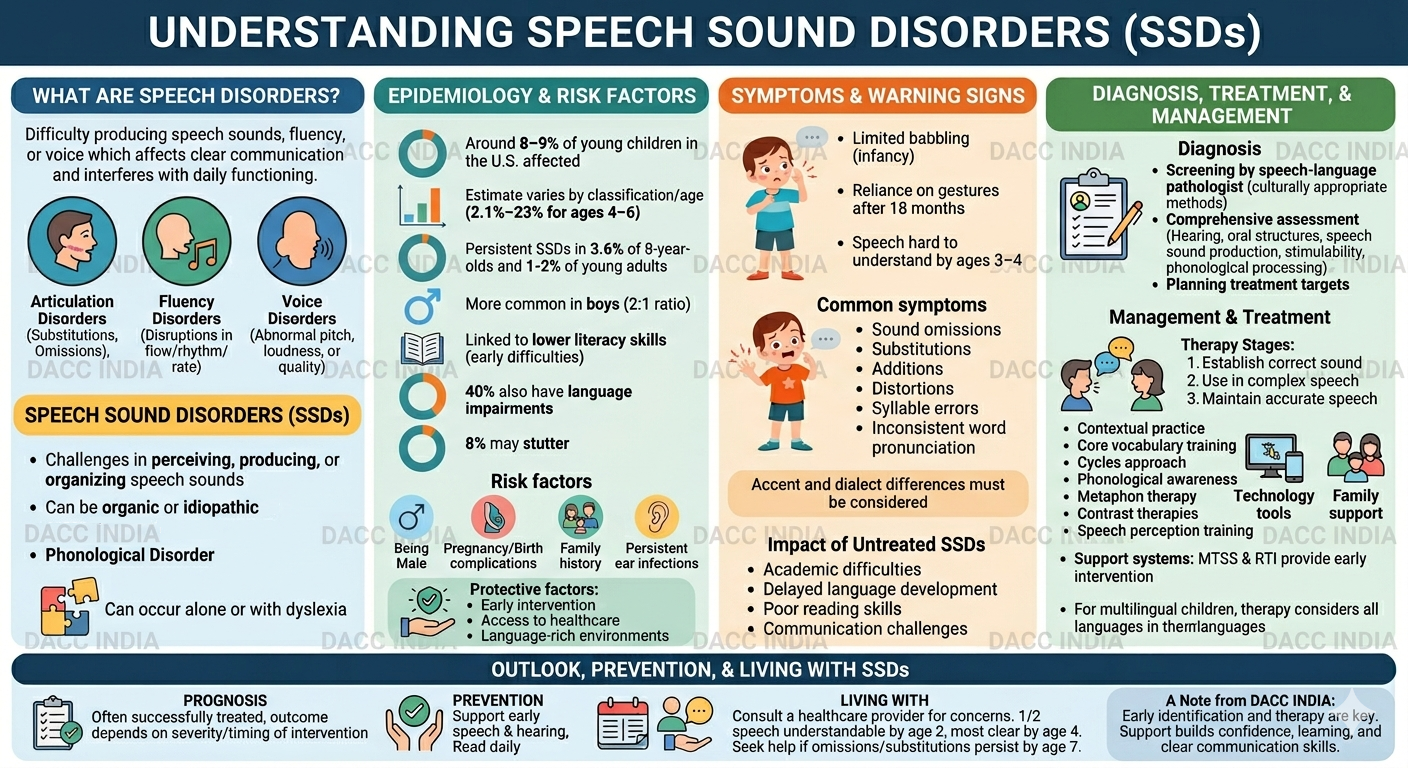
A speech disorder is a difficulty with producing speech sounds, fluency, or voice, which can affect clear communication and must interfere with daily functioning to be diagnosed. It includes articulation disorders (errors in producing sounds such as substitutions or omissions), fluency disorders (disruptions in the flow, rhythm, or rate of speech), and voice disorders (abnormal pitch, loudness, or vocal quality inappropriate for age or sex).
Speech sound disorders (SSDs) involve challenges in perceiving, producing, or organising speech sounds. They may be organic (caused by neurological, structural, or sensory conditions) or idiopathic (of unknown cause). Phonological disorder, a type of SSD, affects how children organise sounds in speech, leading to patterns like sound substitutions or omissions that persist beyond early childhood. These disorders can occur alone or alongside learning difficulties such as dyslexia. Treatment with a speech-language pathologist is often effective, and mild cases may resolve by around age six.
Epidemiology
Around 8–9% of young children in the U.S. have speech sound disorders (SSDs), including articulation and phonological disorders. Estimates vary widely due to differences in classification, age groups, and language backgrounds. Research suggests 2.1%–23% of children aged 4–6 have SSDs, 3.6% of 8-year-olds have persistent SSDs, and 1–2% of young adults continue to show speech errors. SSDs are more common in boys (about 2:1 ratio) and may be linked to lower socioeconomic status in some cases. About 40% of affected children also have language impairments, and 8% may stutter. Early speech difficulties are associated with lower literacy skills, and roughly 25% of children receiving speech services may also need reading support.
Symptoms and Causes - Etiology
Speech sound disorder (SSD) makes it difficult for a child to produce all speech sounds clearly, which can affect understanding in everyday communication. While the cause is often unknown, some cases are linked to conditions such as cleft palate, dental issues, hearing loss, or difficulties controlling mouth movements. Warning signs include limited babbling in infancy, reliance on gestures after 18 months, and speech that is hard to understand by ages 3–4.
Risk factors include being male, pregnancy or birth complications, family history of speech or language difficulties, and persistent ear infections. Protective factors like early intervention, access to healthcare, and language-rich environments can improve outcomes.
Common symptoms include sound omissions, substitutions, additions, distortions, syllable errors, and inconsistent word pronunciation. Accent and dialect differences must be considered during assessment to avoid misdiagnosis. If untreated, phonological disorders may lead to academic difficulties, delayed language development, poor reading skills, and communication challenges.
Diagnosis and Test
Screening for speech sound disorders (SSDs) occurs when concerns arise and is conducted in the child’s primary language. It includes checking speech sounds, oral-motor function, facial structure, and basic language skills. Results may lead to monitoring, referrals, or a full assessment.
A comprehensive assessment examines case history, hearing, oral structures, speech sound production, intelligibility, and severity. Speech-language pathologists use culturally and linguistically appropriate methods, especially for multilingual children, to avoid bias and distinguish disorders from accent or dialect differences. Assessment also evaluates stimulability, speech perception, and phonological processing, which are important for reading and language development.
Support systems like MTSS and RTI may provide early intervention, but they cannot delay formal evaluation. Diagnosis involves identifying the type and severity of SSD, planning treatment targets, and referring to other professionals if needed.
Management & Treatment
Treating speech sound disorders (SSDs) can be complex because children often show both articulation and phonological errors that require different approaches. Therapy usually follows three stages: establishing correct sound production, helping the child use sounds in increasingly complex speech, and maintaining accurate speech through self-monitoring.
Target sounds are chosen based on the child’s needs, intelligibility, developmental order, and linguistic theories. Treatment strategies include vertical, horizontal, and cyclical practice schedules. Common therapy approaches include contextual sound practice, core vocabulary training, cycles approach, phonological awareness, metaphon therapy, naturalistic speech practice, contrast therapies (minimal/maximal pairs), motor chaining, and speech perception training. Technology such as visual, tactile, and biofeedback tools may support learning.
For multilingual children, therapy considers all languages and dialects. In schools, eligibility depends on the disorder’s impact on learning and social interaction. Untreated or persistent speech difficulties can affect communication, literacy, self-esteem, and social life, so long-term support, collaboration with families and teachers, and transition planning are important.
Outlook/ Prognosis
Phonological disorder can often be successfully treated, especially when speech therapy begins early. However, the overall outcome depends on how severe the disorder is and how soon intervention starts.
Prevention
Phonological disorder may sometimes be prevented by supporting early speech and hearing development, such as ensuring regular hearing screenings, engaging in listening and speaking games, and reading daily to children. However, speech disorders often occur for unknown reasons, and having a phonological disorder does not mean anyone is at fault.
Living with
Parents should consult a healthcare provider if they are concerned about their child’s speech development. By age 2, about half of a child’s speech should be understandable, and by age 4, most of it should be clear. Seek help if a child cannot produce certain sounds by age 6, feels embarrassed about their speech, or continues omitting or substituting sounds by age 7. Parents can ask about the severity of the disorder, treatment options, duration of speech therapy, and signs to monitor at home.
A Note from DACC INDIA
Speech sound disorders, including phonological disorder, can affect a child’s communication, learning, and confidence. Early identification, accurate assessment, and timely speech therapy are key to improving outcomes. Support from families, teachers, and healthcare professionals, along with language-rich environments and regular hearing checks, can further help children progress. With proper intervention and consistent support, many children develop clear speech and strong communication skills, leading to positive academic and social development.
Refrence links
- https://www.asha.org/policy/rp1993-00208/?srsltid=AfmBOoppfo8melEMsYFKCZQ8Bkh5ehTeIrBtxxuyDMpk4xVINd61GPLL
- https://www.cincinnatichildrens.org/health/c/communication-disorders
- https://www.medicalnewstoday.com/articles/communication-disorders#types
- https://www.verywellmind.com/communication-disorder-types-5220602
- https://my.clevelandclinic.org/health/diseases/phonological-disorder
Case Study
Aarav (pseudonym), a 6-year-old boy studying in Grade 1, was referred by his teacher and parents due to unclear speech and academic concerns. His parents reported that unfamiliar listeners often struggled to understand him, and his teacher observed sound substitutions, difficulty reading aloud, and reduced classroom participation. Aarav had begun avoiding group speaking tasks and showed embarrassment when asked to repeat words. Developmental history revealed mild preterm birth, slightly delayed early speech milestones, and a family history of childhood speech difficulties in his father. He also experienced recurrent ear infections in early childhood and lives in a supportive bilingual home environment.
During assessment, Aarav appeared cooperative but shy, frequently using gestures and short sentences. He showed frustration when repeating unfamiliar or longer words. A comprehensive speech-language evaluation identified sound substitutions, omissions of consonants, difficulty with multisyllabic words, reduced speech intelligibility, and mild phonological awareness and early literacy difficulties. He was diagnosed with a moderate phonological disorder. His speech challenges were affecting academic performance, reading development, self-esteem, and social participation.
A speech-language therapy plan was recommended twice weekly, focusing on accurate sound production, phonological awareness, literacy support, and confidence building, along with home practice and classroom support. After six months, Aarav demonstrated clearer speech, improved reading skills, and greater classroom participation. This case highlights the importance of early identification, collaborative intervention, and consistent support in improving communication, academic progress, and self-confidence in children with speech sound disorders.
Infographics