Social (Pragmatic) Communication Disorder
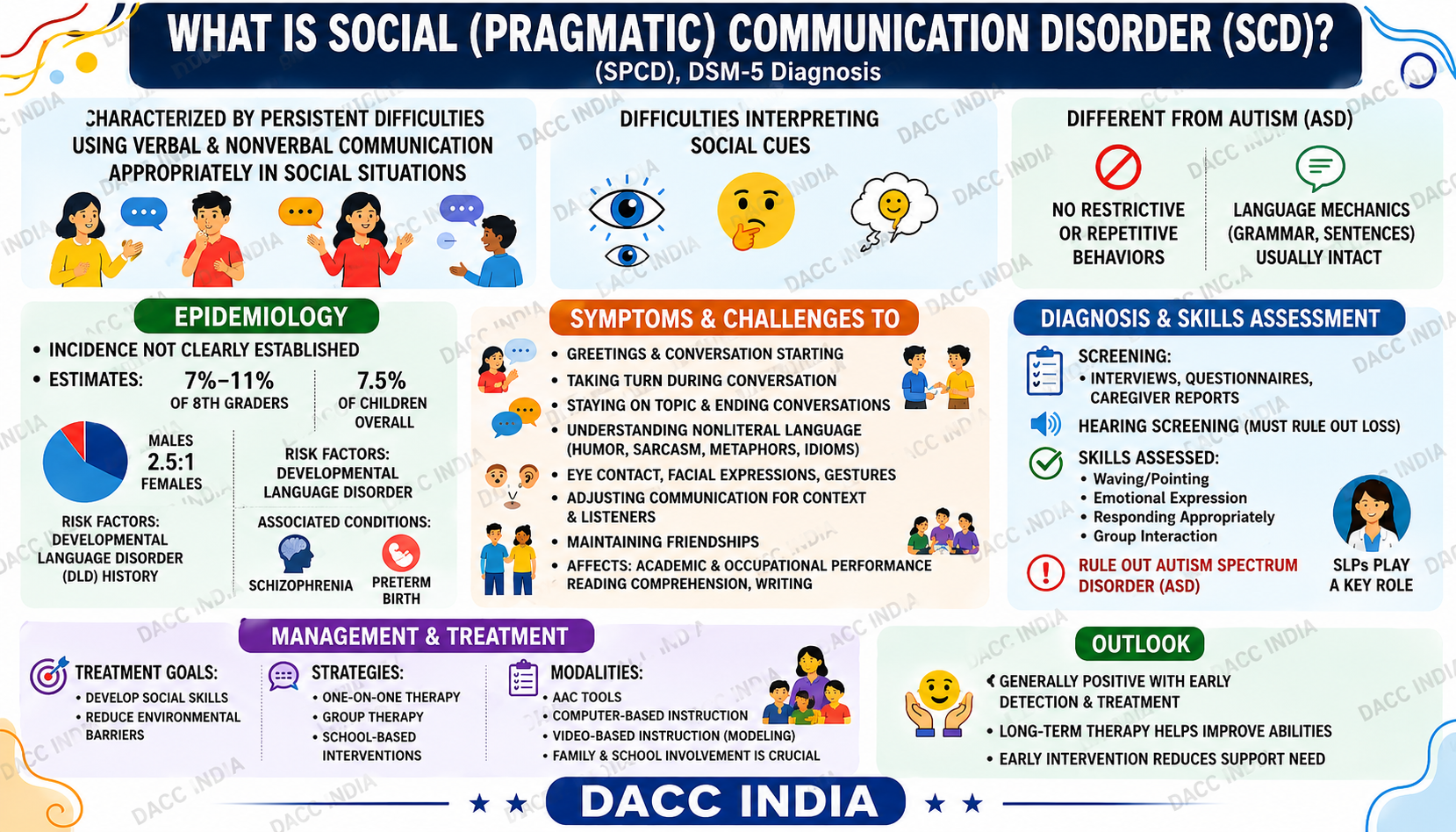
Social (Pragmatic) Communication Disorder (SCD), also known as Social Pragmatic Communication Disorder (SPCD), is a condition characterized by persistent difficulties in using verbal and nonverbal communication appropriately in social situations. Individuals with SCD struggle with understanding social cues, maintaining conversations, interpreting nonliteral language such as humor or metaphors, and adapting communication according to different contexts or listeners. They may also face challenges with eye contact, facial expressions, gestures, and understanding emotions. Unlike Autism Spectrum Disorder (ASD), SCD does not include restrictive or repetitive behaviors, and language mechanics like grammar and sentence formation are usually intact. Introduced as a separate diagnosis in the DSM-5 in 2013, SCD helps identify individuals who experience significant social communication difficulties that affect relationships, academic performance, and daily interactions, enabling them to receive more accurate support and treatment.
Epidemiology
The incidence and prevalence of Social (Pragmatic) Communication Disorder (SCD) are not yet clearly established because the disorder was only recently added to the DSM-5 and studies use varying definitions and populations. Preliminary research estimates that about 7%–11% of eighth-grade children may experience SCD, with approximately 7.5% of children showing social pragmatic communication difficulties overall. Children with a history of Developmental Language Disorder (DLD) are at a significantly higher risk of developing SCD. Studies also suggest that males are more commonly affected than females, with a reported male-to-female ratio of 2.5:1. Social communication difficulties are often associated with other conditions, including schizophrenia and preterm birth, indicating that pragmatic communication impairments may occur alongside various developmental and psychological disorders.
Symptoms and Causes
- Individuals with SCD struggle with:
- Greetings and starting conversations
- Taking turns during conversations
- Staying on topic and ending conversations appropriately
- Understanding indirect or figurative language such as humor, sarcasm, metaphors, and idioms
- Using and understanding eye contact, gestures, and facial expressions
- Adjusting communication according to different social settings or people
- Difficulty interpreting social cues
- Problems maintaining friendships and relationships
- Disorganized storytelling
- Saying inappropriate things during conversations
- Trouble understanding implied meanings and inferences
- Social interaction and communication
- Academic and occupational performance
- Reading comprehension and writing skills
- Interpersonal relationships
- Have trouble listening and phrasing questions
- Struggle to participate effectively in conversations
- Respond minimally to social interactions
- Neurodevelopmental differences
- Genetic influences
- Family history of communication disorders or ASD
Diagnosis and Tests
- Interviews and observations
- Self-report questionnaires
- Parent, teacher, or caregiver report measures
- Competency-based and norm-referenced assessment tools
- Hearing screening is important to rule out hearing loss as a cause of communication difficulties.
- Individuals who fail hearing screening are referred for a full audiological evaluation.
- Children using hearing aids or implantable hearing devices should have these devices checked regularly and worn during screening and assessment.
- Populations commonly considered for SCD screening:
- Social interaction
- Conversation skills
- Understanding nonliteral language
- Attention-Deficit/Hyperactivity Disorder (ADHD)
- Acquired brain injury or traumatic brain injury (TBI)
- Neurological disorders
- History of abuse or neglect
- Disruptive behavior disorders
- Language delays or learning disabilities
- TBI
- Aphasia
- Right hemisphere brain damage
- Neurodegenerative disorders such as Alzheimer’s disease
- Responding appropriately to others
- Using gestures such as waving or pointing
- Taking turns in conversation or play
- Talking about emotions and feelings
- Staying on topic
- Adjusting speech for different people or situations
- Asking relevant questions and giving related responses
- Using language for greetings, comments, promises, and requests
- Making and maintaining friendships
- Autism Spectrum Disorder (ASD) must be ruled out before diagnosing SCD because both conditions involve social communication difficulties.
- Unlike SCD, ASD also includes restricted and repetitive behaviors.
- SCD may occur alongside other conditions such as language disorders, speech sound disorders, learning disabilities, and ADHD.
- Speech-language pathologists (SLPs) play a key role in assessing and treating SCD and often work with teachers and parents to improve social communication skills.
Management & Treatment
- Intervention for Social Communication Disorder (SCD) focuses on:
- Building on strengths and improving communication weaknesses
- Helping individuals develop social communication skills and independence
- Reducing environmental barriers and improving participation in social interactions
- Treatment aims to improve communication in natural social settings.
- One-on-one therapy helps teach specific communication skills.
- Group therapy helps practice social skills and improve interaction with peers.
- Teacher-mediated support
- Peer-mediated interventions
- Environmental modifications
- Treatment Modalities
- Augmentative and Alternative Communication (AAC):
- Uses tools and strategies to support communication
- Includes picture boards, tablets, and speech-generating devices
- Computer-based instruction:
- Uses technology to teach language, social skills, and problem-solving
- Video-based instruction (video modeling):
- Individuals watch videos demonstrating appropriate social behaviors and imitate them
- Assessment Before Treatment
- Individuals must be screened and assessed by professionals such as speech-language pathologists (SLPs).
- Assessments may include:
⦁ Interviews
⦁ Questionnaires
⦁ Self-assessments
⦁ Teacher or caregiver reports
⦁ Hearing tests
- Role of Speech-Language Pathologists (SLPs)
SLPs help improve verbal and nonverbal communication skills
- They teach skills such as:
- Using gestures appropriately
- Turn-taking in conversations
- Starting and ending conversations
- Staying on topic
- Understanding social situations
- Therapy Settings
- Therapy may be provided in:
- Schools
- Clinics
- Hospitals
- Private practices
- Social skills groups
- Family and School Involvement
- Family participation is important for successful treatment.
- Parents are encouraged to help children practice communication skills in daily life.
- Teachers, counselors, and therapists may also support communication development.
Outlook/ Prognosis
- The outlook for individuals with Social Pragmatic Communication Disorder (SPCD) is generally positive with early detection and treatment.
- Long-term speech therapy and social skills training can help improve communication abilities.
- Teenagers and adults may benefit from life skills and social interaction groups.
- SPCD can be a lifelong condition, although symptoms may improve over time.
- Regular monitoring is important to track progress and prevent regression.
- Early intervention can significantly improve social communication skills and reduce the need for ongoing support.
Living With
Children with Social Communication Disorder (SCD) can improve their social communication skills through explicit teaching, guided practice, and consistent reinforcement in everyday situations. Social communication skills are highly dependent on context, meaning that expectations for greetings, conversations, and interactions change according to the environment, relationships, and social situations. Therefore, a rigid or scripted teaching method is often ineffective. Instead, children benefit from learning social awareness and understanding how social rules vary across situations. Programs such as Social Thinking help develop these abilities. Speech-language therapists and mental health professionals play an important role in teaching these skills through individual or group therapy sessions. Practicing with peers in schools, social groups, and other real-life settings is essential for helping children generalize and apply their communication skills effectively. Because SCD can affect academic and social functioning, many children receive support services both in schools and in outpatient therapy settings.
A note from DACC India
Social (Pragmatic) Communication Disorder (SCD) is a communication disorder that affects a person’s ability to use verbal and nonverbal communication effectively in social situations. Individuals with SCD may struggle with conversation skills, understanding social cues, eye contact, gestures, and figurative language such as humor or metaphors. Symptoms usually begin in childhood and can affect relationships, academics, and daily interactions. Diagnosis involves speech and language assessments while ruling out Autism Spectrum Disorder (ASD). Treatment includes speech therapy, social skills training, family support, and school-based interventions. Early identification and intervention can significantly improve social communication and overall functioning.
Refrence links
- https://www.medicalnewstoday.com/articles/communication-disorders#causes
- https://www.verywellmind.com/communication-disorder-types-5220602
- https://www.asha.org/practice-portal/clinical-topics/social-communication-disorder/?srsltid=AfmBOoqOCRv7EKapjfG0bPJRSy-h7Bl23pglF9uJUvvUr5QrRUSLA0qz
- https://www.psychiatry.org/File%20Library/Psychiatrists/Practice/DSM/APA_DSM-5-Social-Communication-Disorder.pdf
- https://www.healthline.com/health/childrens-health/social-pragmatic-communication-disorder
- https://www.churchillstl.org/learning-disability-resources/social-communication-disorder/
- https://manhattanpsychologygroup.com/social-issues-children/
Case Study
Naveen Kumar, a 10-year-old student studying in the 5th standard, was referred for psychological assessment due to persistent difficulties in social communication and peer interaction. Teachers reported that he struggled to initiate and maintain conversations, understand jokes and figurative language, and respond appropriately in social situations. His parents also noticed poor eye contact, limited emotional expression, and difficulty making friends despite normal intelligence and good academic abilities.
Developmental milestones such as walking and speaking were achieved on time, but social communication difficulties became noticeable during early childhood. Naveen often interrupted conversations, misunderstood indirect instructions, and interpreted statements literally. He preferred solitary activities and found group interactions challenging. No repetitive behaviors or restricted interests associated with Autism Spectrum Disorder (ASD) were observed. Behavioral observation revealed that Naveen was cooperative but socially awkward. His speech and grammar were age-appropriate, but conversational flow and understanding of social cues were impaired. Assessment included clinical interviews, teacher reports, pragmatic language evaluation, and hearing screening. Results showed significant difficulties in conversational turn-taking, understanding nonliteral language, maintaining peer relationships, and interpreting facial expressions and gestures. Based on DSM-5 criteria, he was diagnosed with Social (Pragmatic) Communication Disorder. Intervention focused on speech and language therapy, social skills training, family support, and school-based strategies. Teachers and parents were encouraged to provide structured communication practice and guided peer interaction. With early intervention and consistent support, Naveen’s prognosis was considered favourable, with expected improvement in communication, social participation, and overall functioning.
Infographic