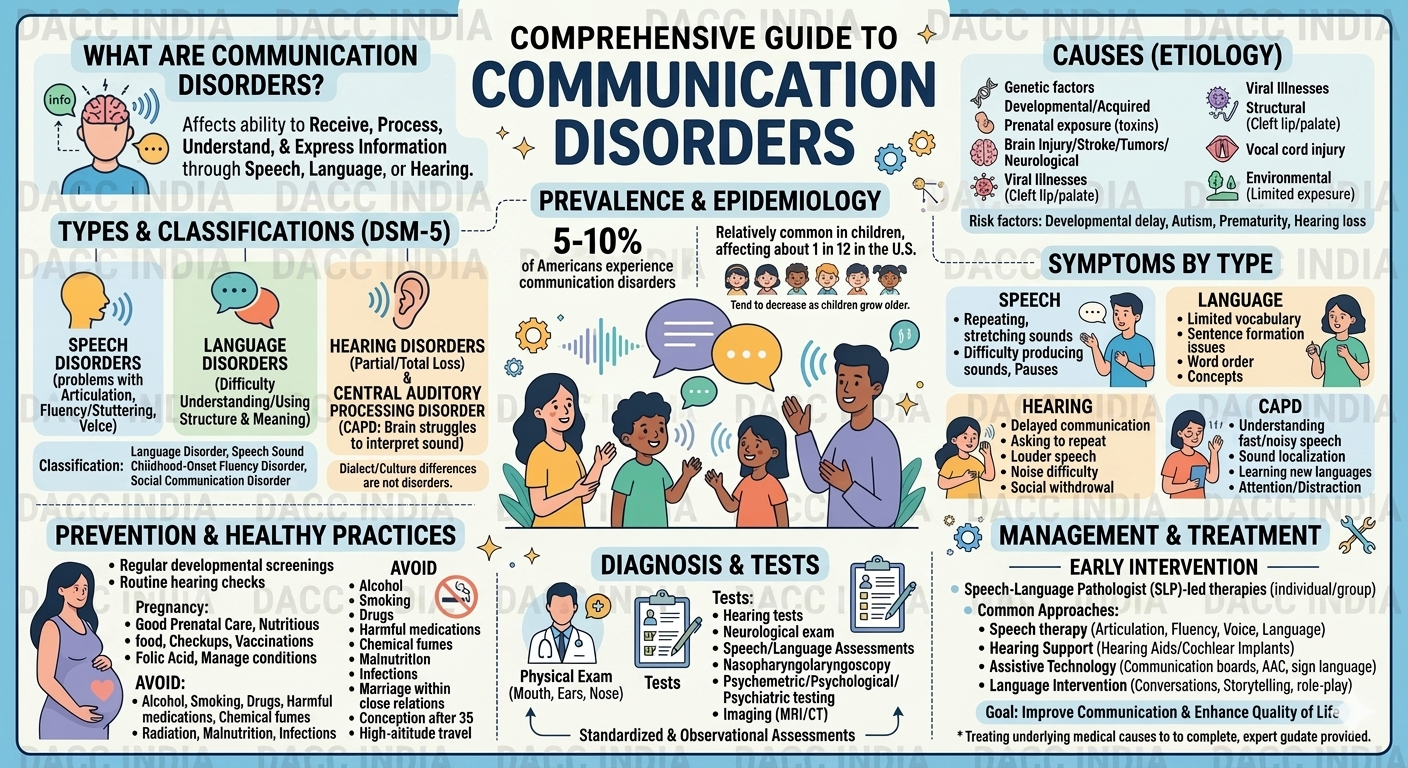
Communication Disorder
Communication disorders are conditions that affect a person’s ability to receive, process, understand, and express information through speech, language, or hearing. They can be developmental or acquired later due to injury, illness, or neurological damage such as stroke, and may occur alone or alongside other disorders. These conditions can range from mild to severe and significantly impact daily communication, learning, and social interaction.
The American Speech-Language-Hearing Association estimates that 5–10% of Americans experience communication disorders, with many children affected by speech or language difficulties. Major types include speech disorders (problems with articulation, fluency, or voice), language disorders (difficulty understanding or using language structure and meaning), hearing disorders (partial or total hearing loss affecting auditory processing), and central auditory processing disorder, where the brain struggles to interpret sound despite normal hearing.
The DSM-5 further classifies communication disorders into language disorder, speech sound disorder, childhood-onset fluency disorder (stuttering), and social (pragmatic) communication disorder. Communication differences due to dialect or culture are not considered disorders, and augmentative or alternative communication systems may support individuals with severe impairments. Early identification and intervention are essential to improve communication skills and help individuals participate fully in education, work, and social life.
Epidemiology
Communication disorders are relatively common in children, affecting about 1 in 12 in the U.S. They are most prevalent between ages 3–6 and tend to decrease as children grow older.
Symptoms and Causes - Etiology
- Often no single known cause; may be developmental or acquired.
- Prenatal exposure to toxins or substances.
- Brain injury, stroke, tumors, or neurological disorders.
- Viral illnesses.
- Structural differences (cleft lip/palate) and vocal cord injury
- Genetic factors.
- Environmental factors such as limited language exposure.
- Higher risk in children with developmental delay, autism, prematurity, hearing loss, craniofacial anomalies, or neurological conditions.
- Speech and language skills
- Language comprehension
- Social cues and emotional understanding
- Gestures and facial expressions
- Repeating or stretching sounds/words
- Difficulty producing sounds
- Adding, omitting, or substituting sounds
- Frequent pauses while speaking
- Jerky movements or excessive blinking during speech
⦁ Limited vocabulary
⦁ Difficulty learning new words
⦁ Trouble forming sentences
⦁ Difficulty understanding concepts and instructions
⦁ Using words in the wrong order
⦁ Delayed oral communication skills
⦁ Asking others to repeat speech
⦁ Speaking louder than usual
⦁ Difficulty understanding speech in noisy environments
⦁ Social withdrawal
⦁ Difficulty understanding fast or noisy speech
⦁ Trouble localizing sounds
⦁ Difficulty learning songs or new languages
⦁ Attention and distraction problems
Diagnosis and Tests
⦁ Physical examination of the mouth, ears, and nose
⦁ Collaboration with specialists (neurologists, speech-language pathologists)
⦁ Hearing tests to rule out hearing loss
⦁ Neurological examination
⦁ Speech and language assessments (sound production, rhythm, language use)
⦁ Nasopharyngolaryngoscopy to examine the voice box
⦁ Psychometric testing for thinking and reasoning abilities
⦁ Psychological testing for cognitive skills
⦁ Psychiatric evaluation for emotional or behavioral concerns
⦁ Imaging tests such as MRI or CT scans
⦁ Standardized tests to compare with age group
⦁ Observational assessments in real-life communication settings
⦁ Comparison of children’s language skills with developmental milestones
Management and Treatment
⦁ Treatment is usually led by a speech-language pathologist (SLP) and depends on the type and severity of the disorder.
⦁ Therapy may be individual or group-based and often involves a multidisciplinary team (physical and occupational therapists, teachers, healthcare professionals, and family members).
⦁ Underlying medical causes, such as infections, are treated alongside therapy.
⦁ Early treatment is critical, especially during toddler and preschool years when language development is rapid.
⦁ Parents are guided to support speech and language development at home.
⦁ Active therapy often begins between ages 2–4, and children with speech or language concerns should also receive hearing tests.
⦁ Speech therapy: articulation practice, fluency training, voice exercises, and language enrichment.
⦁ Hearing support: hearing aids or cochlear implants for hearing loss.
⦁ Assistive technology: communication boards, speech-generating devices, and AAC or sign language.
⦁ Language intervention activities: conversations, storytelling, books, pictures, and role-play to build skills.
⦁ Improve communication abilities and enhance quality of life.
Outlook/ Prognosis
⦁ Family history: Language disorders often run in families, making genetics a major risk factor.
⦁ Gender: Males are more likely than females to develop language disorders.
⦁ Medical conditions: Disorders such as aphasia, apraxia, and dysarthria increase risk.
⦁ Stroke: About 25–40% of stroke survivors develop aphasia.
⦁ Traumatic brain injury: More severe brain injuries raise the likelihood of communication disorders.
Prevention
- Premature birth and low birth weight
- Family history of communication disorders
- Brain injuries or infections
- Exposure to drugs or alcohol during pregnancy
- Possible complications: social isolation, academic difficulties, and mental health challenges due to communication problems
- Early detection and intervention through regular developmental screenings
- Routine hearing checks for infants and toddlers
- Good prenatal care to reduce risks linked to prematurity and low birth weight
- Provide a rich language environment: talk, read, and engage children in conversation
- Eat nutritious food and take prescribed medications only
- Maintain hygiene and attend regular prenatal checkups
- Get recommended vaccinations and prenatal screenings
- Take folic acid supplements and manage conditions like diabetes or high blood pressure
- Alcohol, smoking, drugs, harmful medications, chemical fumes, and radiation exposure
- Malnutrition, infections, and injuries
- Marriage within close blood relations, conceiving after age 35, and high-altitude travel during pregnancy
A note from DACC India
Communication disorders affect a person’s ability to understand, process, hear, or express language and speech. They may be developmental or caused by injury, illness, or neurological conditions such as stroke. These disorders range from mild to severe and can impact learning, social interaction, and daily life. Common types include speech, language, hearing, and central auditory processing disorders. Causes include genetic, neurological, prenatal, and environmental factors. Diagnosis involves medical and speech-language assessments. Early intervention, speech therapy, hearing support, and assistive communication tools help improve communication skills and overall quality of life.
Refrence links
- https://www.medicalnewstoday.com/articles/communication-disorders>
- https://www.asha.org/policy/rp19930208/?srsltid=AfmBOoppfo8melEMsYFKCZQ8Bkh5ehTeIrBtxxuyDMpk4xVINd61GPLL
- https://continentalhospitals.com/diseases/communications-disorder
- https://www.verywellmind.com/communication-disord er-types-5220602
- https://www.cincinnatichildrens.org/health/c/communication-disorders
- https://aiishmysore.in/storage/files/tips-to-prevent-communication-disorders-in-infants-english.pdf
Case Study
Ishaan is a 7-year-old boy who knows exactly what he wants to say, but his brain and speech muscles sometimes have trouble staying in sync. This causes him to get “stuck” on certain sounds or repeat words, which is often called stuttering. While he is very bright and does great in subjects like math and art, the struggle to get his words out has made him feel shy and nervous about talking in front of his class. To avoid being embarrassed, he has started staying quiet or pointing at things instead of speaking. His therapy focuses on two main goals: giving him physical “tricks” to help his words flow more smoothly and building his confidence so he feels brave enough to speak even when he hits a rough patch. By teaching him that his voice is important regardless of how it sounds, and by having his teachers and parents create a relaxed, pressure-free environment, Ishaan is learning to find his voice and connect with others again.
Infographic