Language Disorder
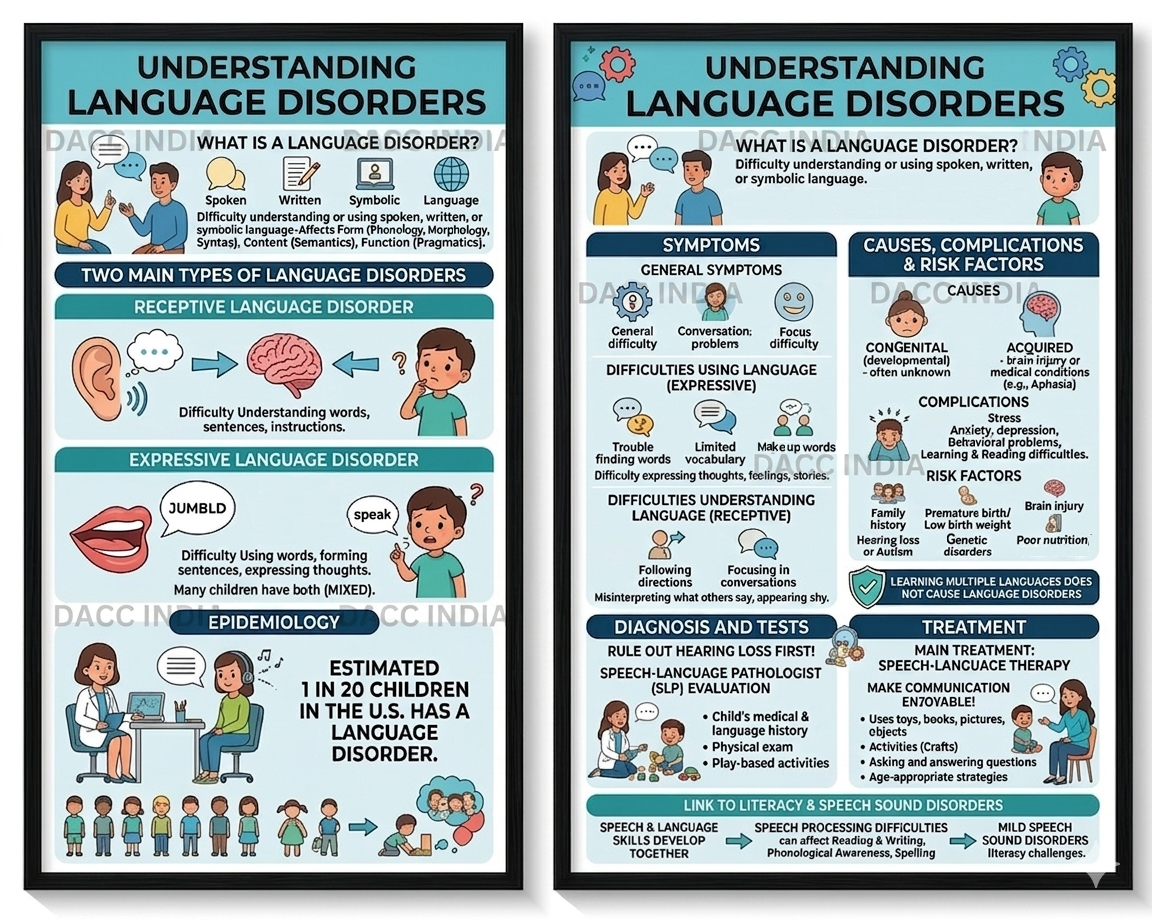
A language disorder is a difficulty in understanding or using spoken, written, or symbolic language. It can affect the form of language (phonology, morphology, syntax), content (semantics), and function (pragmatics). These difficulties may appear in speaking, understanding, reading, or writing.
There are two main types: receptive language disorder (difficulty understanding words, sentences, and instructions) and expressive language disorder (difficulty using words, forming sentences, and expressing thoughts). Many children experience both. Causes may include hearing loss, intellectual disability, brain injury, emotional disturbance, or limited language exposure, though often the cause is unknown.
Warning signs include delayed speech milestones, trouble following instructions, limited vocabulary, incorrect word use, and difficulty forming sentences. Language disorders may be present from birth or acquired later due to injury or illness. Although often lifelong, speech and language therapy can significantly improve communication skills and quality of life.
Epidemiology
Experts estimate that about 1 in 20 children in the U.S. has a language disorder, including those whose communication is affected by conditions such as autism spectrum disorder or hearing loss.
Symptoms and Causes - Etiology
- Difficulty using and/or understanding spoken, written, or sign language
- Symptoms vary depending on type and cause
- Trouble finding the right words
- Limited vocabulary for age
- Making up new words
- Leaving out words or mixing verb tenses
- Repeating words/phrases frequently
- Using short or simple sentences
- Avoiding social interactions
- Difficulty expressing thoughts, feelings, stories, and asking questions
- Trouble following directions
- Difficulty focusing during conversations or in noisy environments
- Missing conversation details or overall context
- Difficulty understanding jokes, puns, or figurative language
- Misinterpreting what others say
- Appearing shy or withdrawn
- Expressive language disorder: difficulty using words to communicate
- Receptive language disorder: difficulty understanding spoken or written language
- Mixed receptive–expressive disorder: difficulty with both
- Congenital (developmental) — often unknown
- Acquired — brain injury or medical conditions (e.g., aphasia)
- Anxiety, depression
- Behavioral problems
- Learning and reading difficulties
- Family history of language disorders
- Premature birth or low birth weight
- Hearing loss or autism
- Genetic disorders (Down syndrome, Fragile X)
- Brain injury, stroke, tumors, cerebral palsy
- Poor nutrition or fetal alcohol exposure
- Learning multiple languages does not cause language disorders.
Diagnosis and Tests
- First step: rule out other causes, especially hearing loss
- Referral to an audiologist for hearing tests if needed
- Referral to a speech-language pathologist (SLP) for evaluation, diagnosis, and treatment
- Healthcare provider reviews:
⦁ Child’s medical and language history
⦁ Physical examination
⦁ Hearing assessment
- Assessment is often done through play-based activities
- May be in group or one-on-one settings
- SLP observes how the child:⦁ Speaks and listens
⦁ Follows directions
⦁ Understands words and object names
⦁ Repeats phrases or rhymes
⦁ Participates in language activities
- Main treatment: Speech-language therapy
- Focus on making communication enjoyable and engaging
- SLP may:
⦁ Use toys, books, pictures, and objects
⦁ Conduct activities like crafts
⦁ Practice asking and answering questions
⦁ Choose age-appropriate strategies based on the child’s needs
- Includes spoken language assessment (listening and speaking)
- May use receptive language tests or sentence imitation tasks if speech is unclear
- Includes written language assessment (reading and writing)
- Speech and language skills develop together
- Speech processing difficulties can affect:
⦁ Reading and writing
⦁ Phonological awareness
⦁ Spelling - Even mild speech sound disorders increase the risk of literacy challenges.
A note from DACC India
Language disorders affect a child’s ability to understand and use language, influencing communication, learning, and social development. Early identification, proper diagnosis, and speech-language therapy are essential for improving outcomes and preventing academic and emotional difficulties. With supportive environments, family involvement, and targeted intervention, children can strengthen their language, literacy, and social skills. Timely support greatly enhances confidence, participation, and overall quality of life.
Refrence links
- https://www.asha.org/policy/rp1993-0208/?srsltid=AfmBOoppfo8melEMsYFKCZQ8Bkh5ehTeIrBtxxuyDMpk4xVINd61GPLL
- https://www.cincinnatichildrens.org/health/c/communication-disorders
- https://www.medicalnewstoday.com/articles/communication-disorders#types
- https://www.verywellmind.com/communication-disorder-types-5220602
- https://my.clevelandclinic.org/health/diseases/language-disorders
- https://www.stanfordchildrens.org/en/topic/default?id=language-disorders-in-children-160-238
- https://aiishmysore.in/pdf/1_1_Prevention_of_S&L_Disorder_English.pdf
Case Study
Meera is a bright six-year-old girl who is like a gifted artist with a head full of ideas, but a missing set of tools to share them. While she is excellent at visual tasks like solving puzzles or drawing, she struggles with the “code” of language. In the classroom, she often feels lost because she can’t quite keep up with spoken instructions, and when she tries to speak, she uses very short sentences and struggles to find the right words. It is not that she isn’t smart—in fact, her brain is very sharp—she just processes words differently than other children. To help her, her teachers and therapists use pictures and visual signs to help her understand what is being said, while a specialist works with her to build her vocabulary and help her put her thoughts into clear sentences. By leaning on her natural talent for seeing and doing, the goal is to give her the “bricks” she needs to build her sentences so she can finally share her big ideas with everyone around her.
Infographic